Becton, Dickinson and Company (BD) works in bioscience, where its BD Biosciences business supports researchers with flow cytometry and scientific analysis tools.
Since 2016, Wildstream has built a recommendation engine that designs multi-colour flow cytometry panels in minutes rather than days, and modernised BD’s research analysis platform so non-experts can run advanced analysis.
Researchers design multi-color flow cytometry panels in minutes rather than the days that manual compatibility checks could take
Users without a background in statistics or biology can now run advanced analysis that once required deep domain expertise
Compatibility is verified across multiple reagents and lasers at once, a check researchers previously worked through by hand
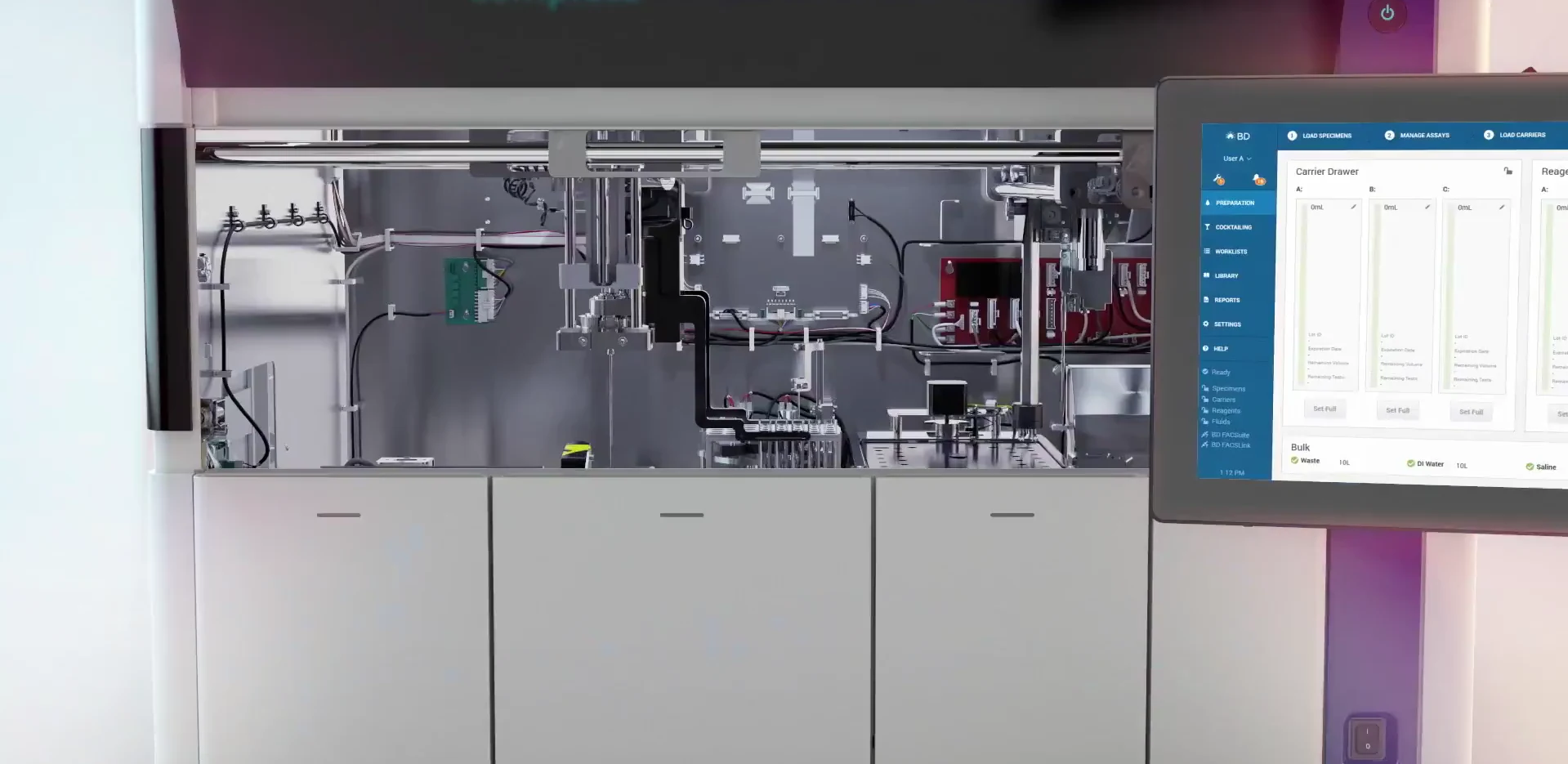
Designing complex flow cytometry panels means checking compatibility between many reagents and lasers, which can take days. Every multi-color panel requires verifying that several reagents work together with the available lasers. The more colors a panel uses, the more combinations need checking before an experiment can start.
Researchers design multi-color flow cytometry panels in minutes rather than the days that manual compatibility checks could take.
Compatibility is verified across multiple reagents and lasers at once, a check researchers previously worked through by hand.
Optimized search algorithms explore possible reagent combinations quickly, so researchers do not test options one by one.
Sponsored by BD's platform management, Wildstream developed a recommendation engine that combines statistical modeling with optimized search algorithms. Researchers set out what their panel needs, and the engine suggests reagent combinations that are compatible with each other and with the lasers, so researchers can move from panel design to experiment much sooner.
Statistical models estimate how well reagents work together and with each laser, so conflicts show up before lab work.
Optimized search algorithms narrow a large set of possible reagent combinations down to the ones that are compatible.
Researchers receive suggestions for compatible reagent combinations instead of building every panel from a blank sheet.
Researchers move from panel design to running flow cytometry experiments much sooner than with manual compatibility checks.
Compatibility knowledge is built into the engine, so less experienced researchers can also design complex panels with confidence.
Checking every combination systematically reduces the risk of incompatible reagents slipping into a panel and spoiling a run.
Legacy scientific software was hard to maintain and scale, and usable only by domain experts. The software had become a bottleneck for BD, which needed a more accessible, future-ready platform for its research users.
Users without a background in statistics or biology can now run advanced analysis that once required deep domain expertise.
More teams generate insights faster, since analysis no longer depends on the few specialists who mastered the legacy tool.
BD replaced a legacy bottleneck with a cloud platform built to keep evolving as research needs and user numbers grow.
Wildstream worked alongside BD’s scientific and product teams on BD Research Cloud. The analysis algorithms are based on MIT research and BD’s own expertise, and the redesign removes technical barriers while preserving scientific integrity, so more teams can turn their data into insights faster.
A redesigned interface removes technical barriers, so researchers focus on their scientific questions rather than on operating the software.
A modernized architecture replaces the legacy codebase, making the platform easier to maintain and ready to scale with BD’s needs.
Algorithms based on MIT research and BD’s own expertise keep results scientifically sound while the interface stays simple.
Simplifying the tool did not dilute the science: the redesign removed barriers while keeping analysis results rigorous and trustworthy.
Moving off hard-to-maintain legacy software frees BD’s teams from patching an aging codebase and lets them focus on new features.
Researchers run analyses themselves instead of queuing requests with specialists, which shortens the path from experiment to result.