Growzer connects hospitality companies, wholesalers and manufacturers on a cloud platform we've built and run since 2016.
AI fills in recipe data from dish names, descriptions and photos
Weather, events and holidays drive daily forecasts per outlet and SKU
Every wholesaler’s products mapped to one standard, without duplicates
Chefs see digitizing recipes as tedious and low-value, so onboarding relies on manual work by the sales team and menu data stays incomplete. Growzer’s sales team handled this by hand during onboarding, which slowed the process and limited data completeness.
Of the required recipe information is auto-completed in the menu engineering module, straight from a dish photo or name.
Recipes no longer wait for the sales team to type them in, so newly signed restaurants start using Growzer sooner.
The AI drafts every recipe, leaving only minor adjustments for the chef or the onboarding team to review and confirm.
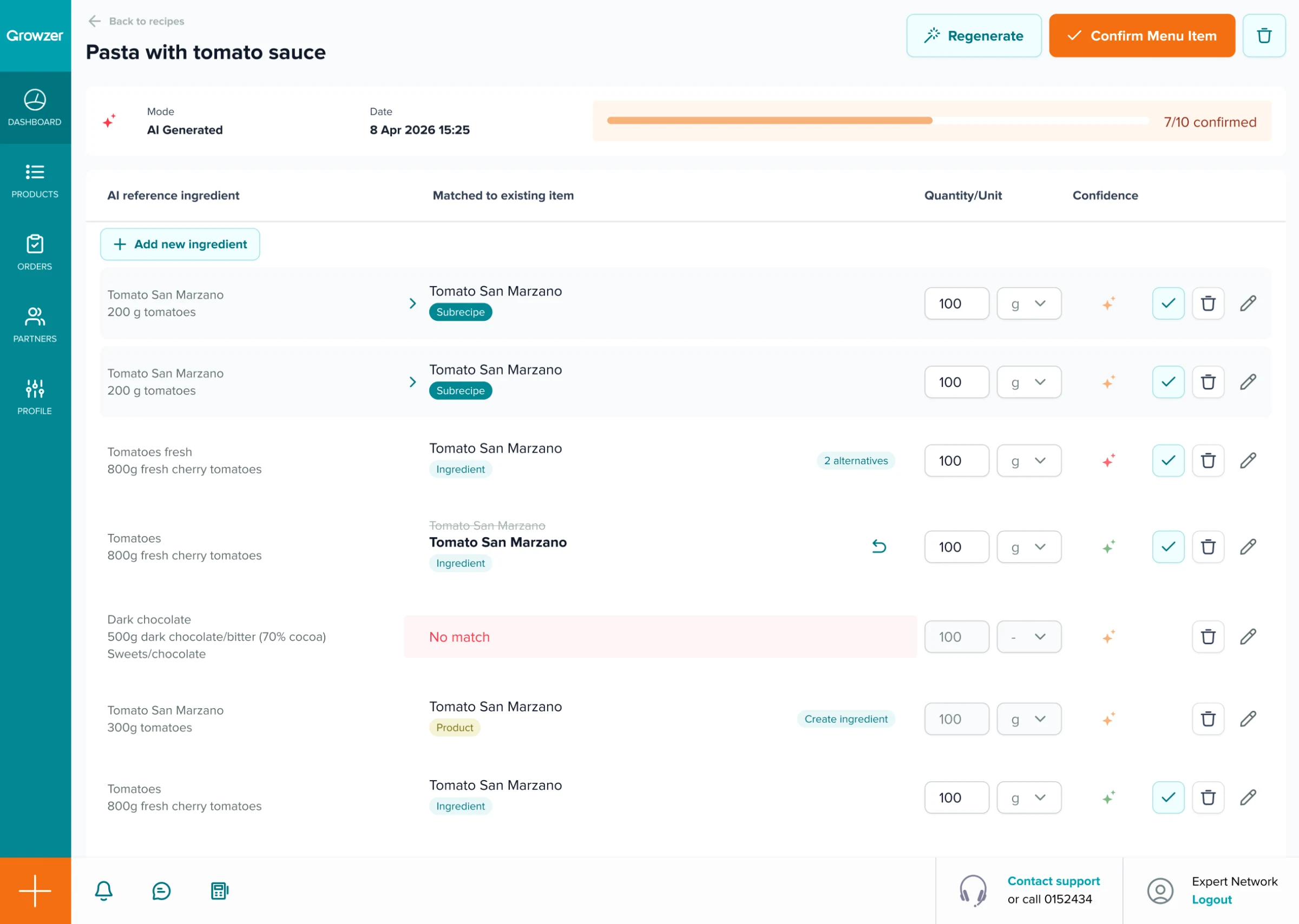
An AI assistant embedded in the Growzer onboarding flow combines image recognition with language understanding and proposes each structured recipe directly inside the menu engineering module, ready for the chef to review.
Vision AI labels a dish photo and identifies its ingredients and structure, turning the image into a recipe draft automatically.
NLP reads dish names and descriptions to infer the likely ingredients, cooking methods and portion sizes behind every dish.
Prototyped on annotated chef datasets, tuned with structured human feedback and iterated with the onboarding team in the Growzer beta.
Restaurants start on Growzer with recipe data that is complete from day one, so menu and cost tools work immediately.
Menu digitization no longer depends on chefs’ willingness to type up recipes, a task they find time-consuming and low-value.
Structured AI drafts replace incomplete manual entries, raising the overall quality of menu data across the Growzer platform.
Complete recipes lay the groundwork for profitability analysis per dish, showing which menu items truly earn their place.
The structured recipe base enables future dynamic menu optimization, so menus can adapt as costs and demand change over time.
Recipes are not linked to the products restaurants actually buy, so they cannot drive ordering or cost analysis. Recipe digitization during Growzer onboarding was handled manually by the sales team, which limited data completeness.
Each proposed ingredient is resolved to an actual wholesaler SKU, the same product the restaurant really buys and receives.
Recipes become immediately actionable for ordering, with no manual product lookup between the menu and the supplier catalogue.
Because every ingredient points to a real product, recipes become the basis for profitability analysis per dish.
A product matcher, or SKU resolver, works against the catalogues of the wholesalers connected to Growzer. It estimates the ingredients and quantities each dish needs, finds the matching product codes and is validated against live wholesaler data.
The system guesses which ingredients a dish needs and in what quantities before looking for the matching wholesaler products.
A product matcher searches wholesaler catalogues for the item behind each ingredient, turning a recipe line into an orderable SKU.
Matches are validated against live wholesaler data, so the proposed products reflect what can actually be ordered today.
Recipes arrive already linked to wholesaler products, so onboarding no longer needs a manual lookup for every single ingredient.
Recipe data is tied to real wholesaler products from the start, raising the quality of menu data restaurants rely on.
Product-linked recipes enable future dynamic menu optimization, letting menus adapt as product availability and costs change.
Every wholesaler classifies food products differently, blocking cross-supplier search, deduplication and analytics. The lack of standardization limits analytics, filtering and interoperability across all Growzer-connected suppliers.
Every product from every connected wholesaler is mapped to FoodEx2, an industry-standard food classification system.
Product duplication is removed from cross-wholesaler data, so the same item from different suppliers appears only once.
One shared classification opens the door to unified multi-wholesaler search in Growzer, across all connected suppliers.
GPT 5 enriches brief product names into detailed descriptions and normalizes them to English. Cohere multilingual embeddings and a Pinecone vector database then retrieve the closest FoodEx2 categories, and GPT 5 selects and verifies the final match.
Works with both structured and messy product descriptions, extracting detailed information even from very brief product names.
Supports product data in multiple languages, with automatic translation to English before matching and classification begin.
Each category choice gets a confidence score; low-confidence results fall back to Miscellaneous Products instead of being misfiled.
Regex and embedding-based fallback matching covers edge cases and outliers, ensuring near-complete coverage of supplier catalogues.
Consistent categories make filtering, analytics and reporting dependable across all suppliers connected to the Growzer platform.
A shared taxonomy lays the foundation for comparing prices and quality across different wholesalers, product by product.
New wholesaler catalogues run through the same pipeline, so classification scales as more suppliers join the Growzer platform.
Unpredictable demand makes restaurants over- or under-order, causing food waste, stockouts and irregular wholesaler logistics. Wholesalers face logistics inefficiencies from the resulting variable order patterns.
Weather, local events, public holidays and terrace openings are combined with sales history to predict demand per outlet.
The engine forecasts daily dish sales for every outlet down to the SKU level, the detail ordering actually needs.
More accurate demand signals mean restaurants stop over-ordering, cutting food waste while still avoiding costly stockouts.
Time series models per outlet and SKU set the baseline from each restaurant’s sales history, while gradient boosting and ensemble models combine it with signals from weather, event and holiday APIs. The predictions drive automatic ordering within Growzer, with no manual intervention needed.
Temperature, rainfall and seasonal patterns shift dish demand significantly, especially for terrace and seasonal menus.
Public holidays, concerts, sports events and school calendars act as demand multipliers for each outlet’s location.
Per-restaurant and per-SKU sales history forms the baseline, continuously updated as new data flows in from Growzer.
Restaurant operators no longer make manual ordering decisions; Growzer places their orders automatically from the forecast.
Wholesalers receive predictable order volumes instead of erratic patterns, making delivery planning far more efficient.
Inventory is restocked just in time across the supply chain, so restaurants hold less stock without running short.
The forecasts are the key enabler of Growzer’s full auto-ordering flow, connecting demand prediction to actual purchasing.
Restaurants and their suppliers both gain from more reliable ordering, raising customer satisfaction across the whole chain.
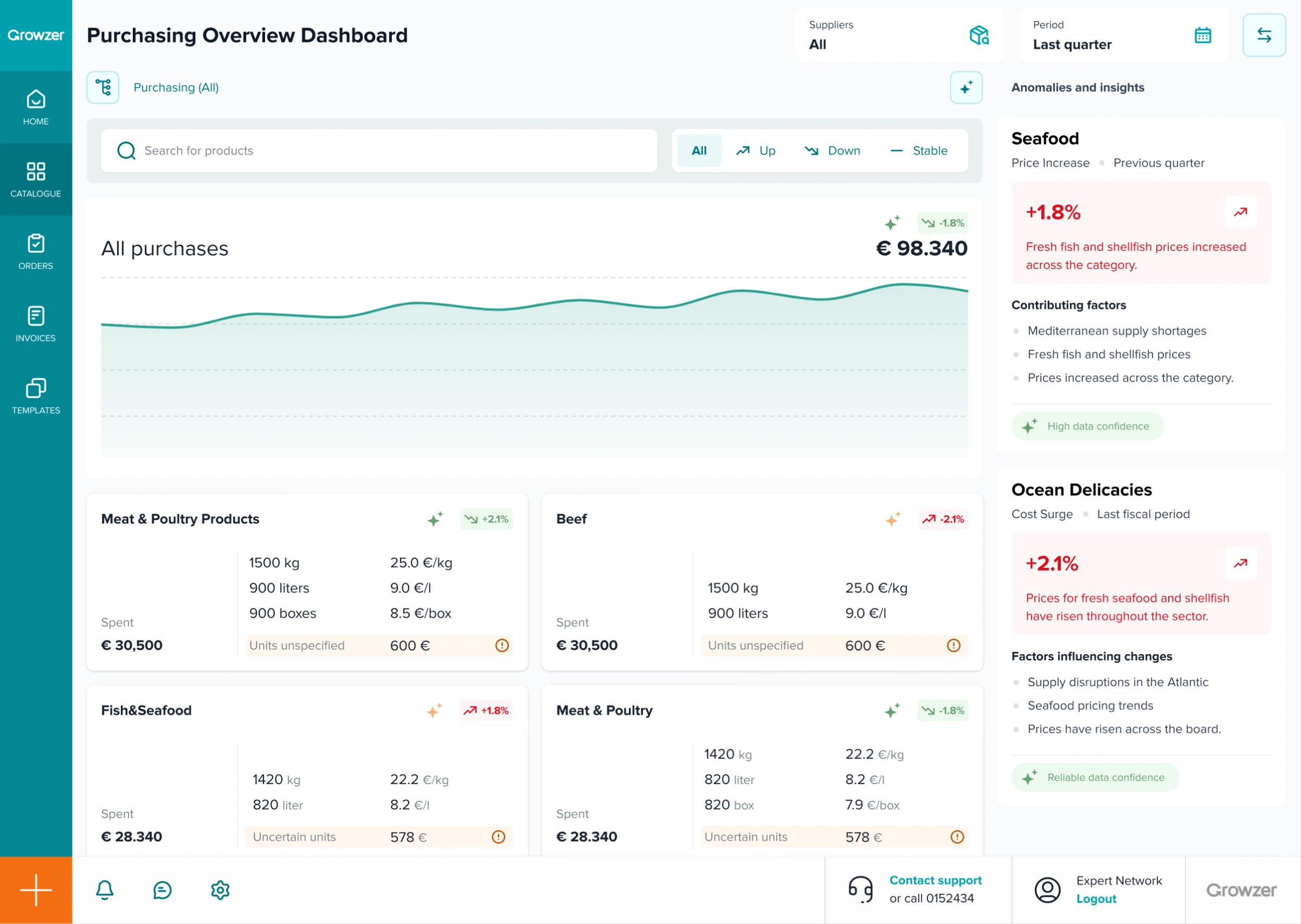
Restaurants juggle stock, invoices, orders and bookings across disconnected tools. The particularities of the HoReCa market require robust processes and varied features, so Growzer needed a modern online platform that could handle these tasks efficiently while simplifying the work of entrepreneurs and users.
Growzer works with Unilever, Lantmännen Unibake, Sligro and Metro, proving its value in today’s hospitality ecosystem.
Restaurants gain productivity and tighter controls while running their business at lower cost, all from one platform.
The platform keeps expanding with new modules and integrations without losing the quality of service users rely on.
It runs on Microsoft Azure, with an ASP.NET web application backed by an MS SQL Server database at its core for performance, security, scalability and flexibility. A clean design and an intuitive, responsive interface keep it simple for entrepreneurs and their teams.
Calculates food cost per recipe and ingredient, showing which dishes are most profitable, which sell best and which to replace.
A cloud-based purchase system lets venues order from all their preferred suppliers in one place, in just a few clicks.
Up-to-date stock information gives managers a complete, current overview of their inventory at any moment of the day.
A responsive interface lets teams place orders and check figures on any device, from the kitchen floor or the office.
Internal processes run automatically, freeing entrepreneurs and their teams to focus on guests instead of paperwork.
Smart insights and ML-based sales predictions turn daily platform data into clear guidance for running each outlet.
Updated stock information and a highly functional purchase order system help keep restaurant customers consistently satisfied.
Restaurants lack up-to-date supplier pricing and stock information and a view of staff costs. The particularities of the HoReCa market, from food stocks to invoices and orders, require robust processes and varied features.
Links with supplier ERP systems bring updated pricing straight into Growzer, so every order uses current prices.
The availability of goods is pulled from supplier systems, so restaurants see what can actually be delivered before ordering.
Connections with HR management systems report human-related costs, giving restaurants a clear view of their staff spending.
Updated pricing and stock availability feed Growzer’s purchase order system, so restaurants order with current information. Human-related costs from HR management systems appear alongside product costs, giving daily overviews of what running the business really costs.
A highly functional purchase order system works directly on live supplier data, keeping every order accurate and current.
Orders to all connected suppliers are placed from one place in Growzer, each using that supplier’s latest information.
Product costs and personnel costs come together in daily overviews, a feature Growzer users single out as clear and user-friendly.
Updated stock information means fewer surprises at delivery, helping ensure customer satisfaction for restaurants and suppliers.
With supplier prices and staff costs in one view, restaurants gain better controls, higher productivity and lower costs.
Pricing and stock updates arrive automatically from supplier systems instead of being collected and entered by hand.
Working with Wildstream is, overall, just a pleasant experience. Quality people, quality processes, quality products, quality advice. Every moment spent with them, about work or just casual conversation, is quality time.