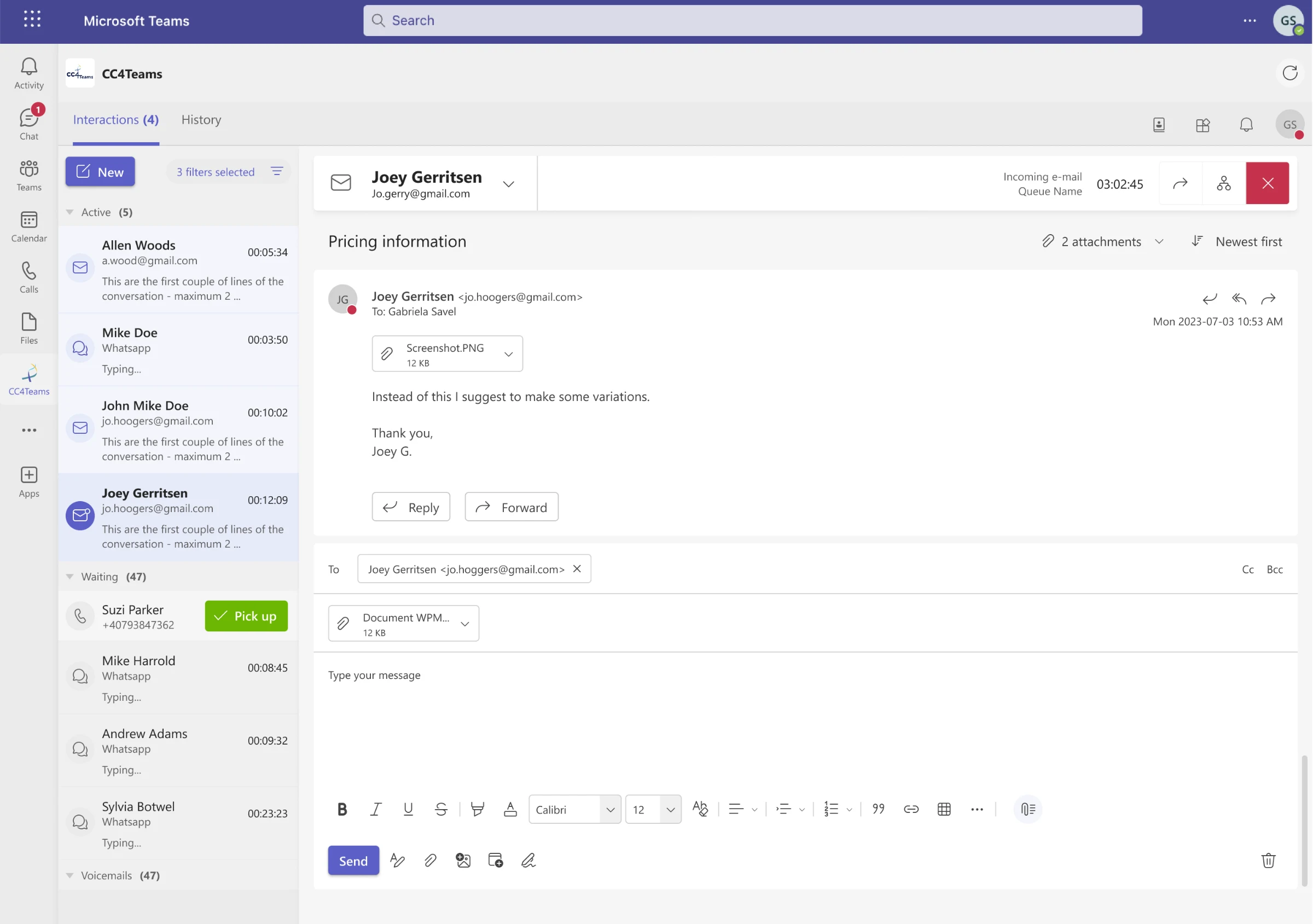
CC4All connects human and AI agents on a Microsoft Teams contact center platform we’ve built and run since 2020 — automating routine conversations while extending service around the clock.
AI summaries cut context-loading from 5–10 minutes to under 30 seconds
Transcripts take processing from 2–3 minutes to 15–30 seconds
Delivered after the zero-downtime move to Microsoft Teams
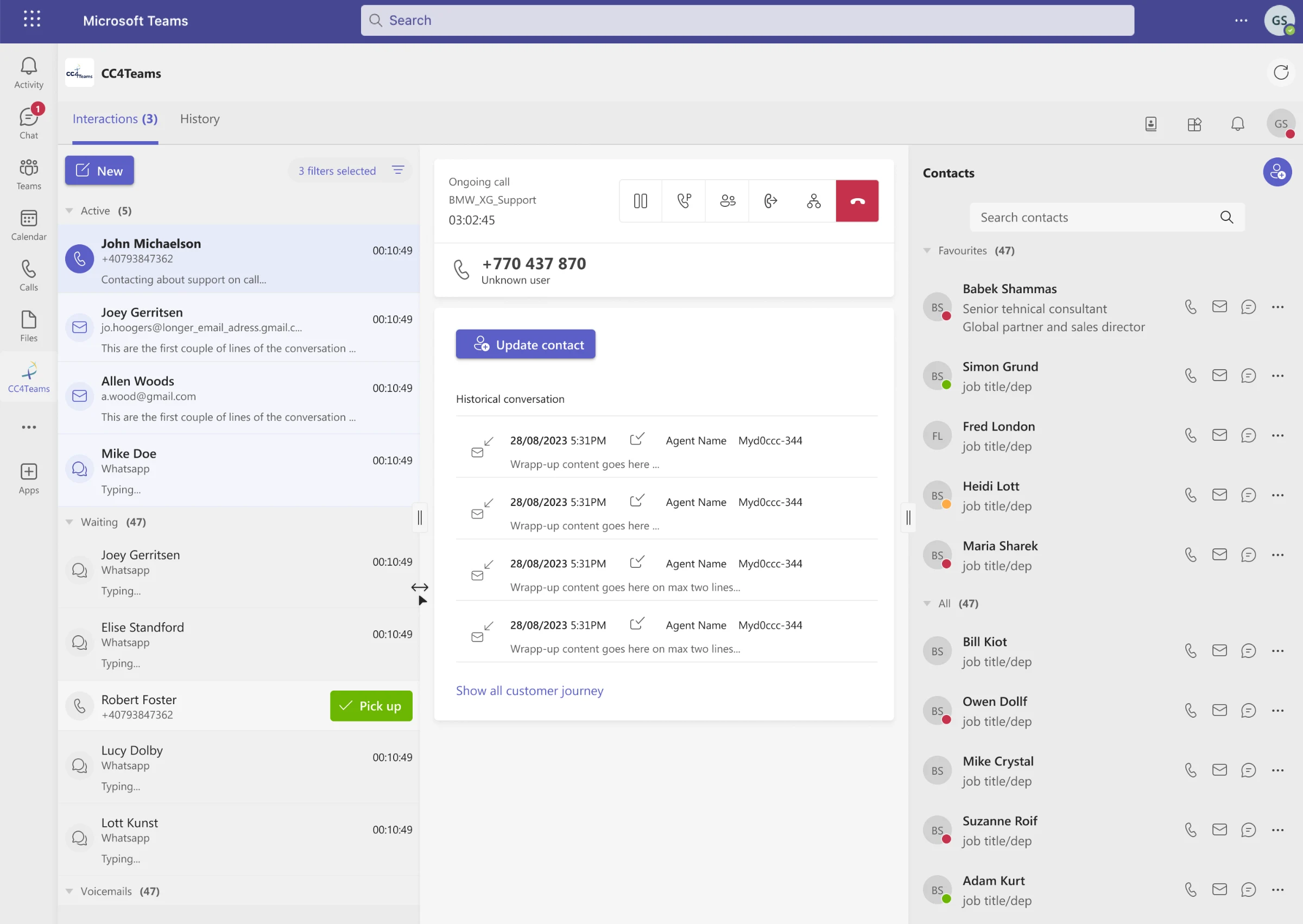
Contact centers rely on finite, expensive human agents — creating gaps in overnight coverage, queue backlogs during peaks, and skilled staff consumed by routine inquiries that don’t require human judgement. Covering low-volume nights, weekends and holidays with people adds cost and complexity.
AI agents answer overnight, weekend and holiday traffic without shifts, fatigue or extra staffing, so no conversation waits for morning.
After-hours coverage comes at a fraction of human staffing cost, replacing low-volume night and weekend shifts with AI agents.
AI agents hold unlimited simultaneous conversations within API rate limits, so peak-hour traffic no longer piles up in the queue.
AI agents sit in webchat queues alongside human agents and accept conversations automatically. They handle routine Tier 1 inquiries end-to-end, keep the full conversation context in real time, and hand a conversation over to a human agent when it needs judgement, empathy or authority.
Conversations beyond AI capability pass to a human agent with the full thread intact, so customers never explain twice.
AI handles Tier 1 volume automatically, reserving human agents for Tier 2+ cases that need judgement, empathy or authority.
Administrators create, configure, activate and monitor AI agents from a full admin UI, linking each one to a knowledge base.
Built on Azure AI Agents (Persistent), each conversation runs in a stateful, context-aware thread that remembers everything said so far.
AI instructions and knowledge come from Microsoft Foundry, where each agent’s persona and knowledge base are configured and maintained.
AI agent activity is tracked in the same reporting system as human agents, giving supervisors one view of everyone.
Routine volume is absorbed by AI agents during peaks, reducing queue depth and keeping waiting times under control for customers.
Skilled agents are freed from routine inquiries to focus on complex, high-value interactions where their judgement makes a difference.
Customers get the same answer to the same question every time, whatever the hour or the volume in the queue.
Agents must listen to every voicemail in real time and log the details by hand, which is slow and leaves voicemail content unsearchable and invisible to reporting. Each message has to be heard, noted and summarised in turn — a sequential bottleneck that makes triage impossible.
Each voicemail takes 15–30 seconds to process instead of 2–3 minutes, because agents read the transcript instead of listening.
Every voicemail is indexed as text, so agents and supervisors can search across all messages instead of replaying audio files.
Voicemail content becomes queryable data for reporting and trend analysis, showing exactly what customers are calling about.
Transcription starts as soon as a customer leaves a message — after a missed call, out of hours or when a queue overflows. The transcript is stored with the recording and shown in the agent interface in real time, and it travels on to downstream notifications such as missed-call alerts.
Missed-call email notifications include the transcript automatically, so the message can be read before anyone opens the platform.
Transcript text is written to the matching case or contact notes in the CRM, without agents copying anything by hand.
Each new voicemail triggers its own transcription job, so processing is non-blocking and runs in real time, whatever the volume.
Supervisors triage the whole voicemail queue at a glance from a text list, instead of listening to each recording.
Voicemails left overnight are reviewed quickly and in parallel each morning, so customers who called after hours get answers sooner.
Key details are already captured in the transcript, so agents no longer write a summary for every message.
Agents spend 5-10 minutes reading long conversation histories before they can respond, and context gets lost at handoffs. This overhead drains cognitive capacity, slows response times and degrades quality under volume pressure.
Context-loading time drops from 5–10 minutes per interaction to under 30 seconds, so agents respond sooner to every customer.
Supervisors review a case in 1–2 minutes instead of 10–15, reading the summary rather than the whole conversation history.
Agents taking over at a shift change start from the saved summary, so no context is lost between colleagues.
Each summary covers customer intent, the resolution steps already taken and the open items in two to five sentences. It is saved to the conversation, so every agent who opens the thread later starts from the same picture.
One consistent AI layer works across email, WhatsApp, webchat and general messaging, so every channel gets the same summaries.
System prompts, AI personas, model and provider — Azure OpenAI or Microsoft Foundry — are set separately for each tenant.
Every AI call reports prompt tokens, completion tokens and model via webhook, giving full cost visibility per feature and channel.
Agents no longer rebuild context by reading long histories, leaving more attention for the customer in front of them.
Agents keep track of every case even when queues are busy, so service quality holds up under volume pressure.
Summaries are suggestions for the agent, never sent to customers, so every reply remains the agent’s decision.
Writing each reply takes agents 3-5 minutes, and quality drops under volume pressure or with new staff. On top of reading conversation history, this overhead drains cognitive capacity and slows response times.
Response drafting time drops from 3–5 minutes per reply to under 1 minute, because agents start from a draft.
New agents reach consistent reply quality in days instead of weeks, because the AI scaffolds every response they send.
Assistants are configured per tenant and tailored to the sector, with setups for insurance, retail and telecoms teams.
Before drafting, the AI reads the full conversation, while a configurable system prompt carries the company’s tone, policy and domain knowledge. The agent reviews the draft, edits it if needed and sends it; the AI never sends a reply on its own.
A configurable system prompt encodes the company’s tone, policy and domain knowledge, so every draft sounds like the brand.
One consistent AI layer drafts replies across email, WhatsApp, webchat and general messaging, whichever channel the customer uses.
Every AI call reports prompt tokens, completion tokens and model via webhook, so costs are visible per feature and channel.
Every reply follows the same tone and policy, so quality stays consistent across the team as volume grows.
Drafts are only suggestions: the agent decides what goes out, so nothing reaches a customer without human review.
Agents edit a ready draft instead of composing each reply from scratch, keeping more energy for complex cases.
A contact center vendor struggled with technical debt, bugs and user complaints, and needed to move to the cloud without losing functionality. It was looking for a proficient, reliable team to improve platform performance and scalability, and for an easy-to-deploy, cost-effective cloud platform such as Microsoft Teams.
Lower support demand freed capacity to implement up to 70% of the client’s wish list for the hybrid project.
The apps stayed stable and scalable throughout the move to the cloud, with no downtime for the platform’s users.
Reduced effort for fixing bugs gave the team extra time to add value to the platform instead of firefighting.
The hybrid solution takes advantage of the mature functionalities of Skype for Business Server as well as the benefits of the Teams application, so contact center users keep the features they rely on while the platform moves to the cloud.
The platform integrates with Microsoft Teams, Dynamics and Skype for Business, the communication tools remote teams already rely on.
Safety and data security are built in for users and finances, protecting the people and transactions the platform serves.
Constant guidance, expertise and vision support Contact Center 4all’s ongoing business needs, beyond delivering the requested features.
End users of the contact center platform are happier, with fewer complaints after the move to stable cloud apps.
Support for Contact Center 4all’s customers improved, as the team spends less time on recurring issues and more on service.
Contact Center 4all’s team works with a stress-free mindset, knowing its partner is reliable, highly skilled and trusted.
Once we started our collaboration, everything became more predictable, processes are finely defined, and we know what to expect and when. The quality is better, what is delivered is at a higher level and we feel at ease knowing we are in good hands. They are honest and straightforward about what works and what doesn’t, not just executing our vision but also guiding us and being as passionate about the project as we are.